Code with Claude Extended 2026: 3 Key Lessons for Builders
Field notes from Anthropic's Code with Claude Extended in SF. Thariq Shihipar on HTML plans, Nick Khami on multi-agent design, Philip Parkinson's 24-hour permit build.
New Block Digital Agency
Updated:
Code with Claude was invite only and free this year. Demand for the original day far outstripped capacity, so Anthropic added a second day for independent developers and early-stage founders. NewBlock was in the room for day two.
The official framing was simple: “Code with Claude is where you hear what’s new. Extended is where you see it in the wild.” Day two had three stages running in parallel. A Founder stage for startup operators talking through the bets they made on Claude and the road from prototype to first revenue. A Builder stage for working demos and real code. And Workshops that adapted the same hands-on sessions Anthropic uses to train its own technical staff: shipping a first managed agent, giving it memory, writing evals that move the score, composing multi-agent systems, and a closing live agent battle. Demos and office hours ran all day. The room opened at 8 AM and the closing reception ran until 6 PM.
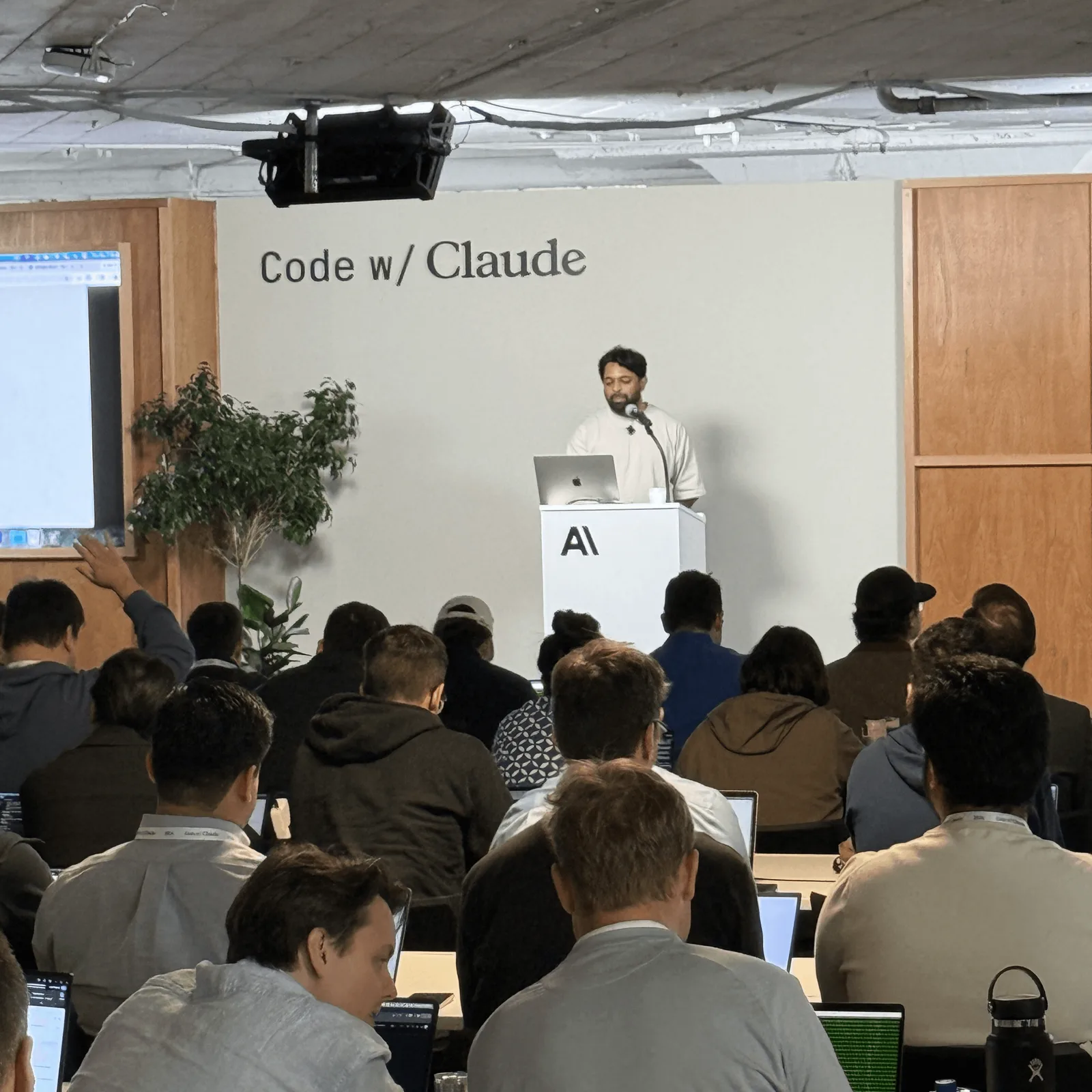
The workshops are now open source on GitHub and worth the weekend. If you’re thinking about how to apply any of this to your own product, our AI integration work covers how we’re building with these tools for clients. Sessions weren’t livestreamed, but recordings will be made publicly available after the event. The talks are where the real signal was. Here are the three lessons worth taking home.
1. Stop Writing Markdown Plans. Start Writing HTML.
Thariq Shihipar from the Claude Code team led the workshop “How we Claude Code,” which reframed how to work with long-running agents. His thesis, which he’s written about publicly, is that Markdown has quietly become the bottleneck.
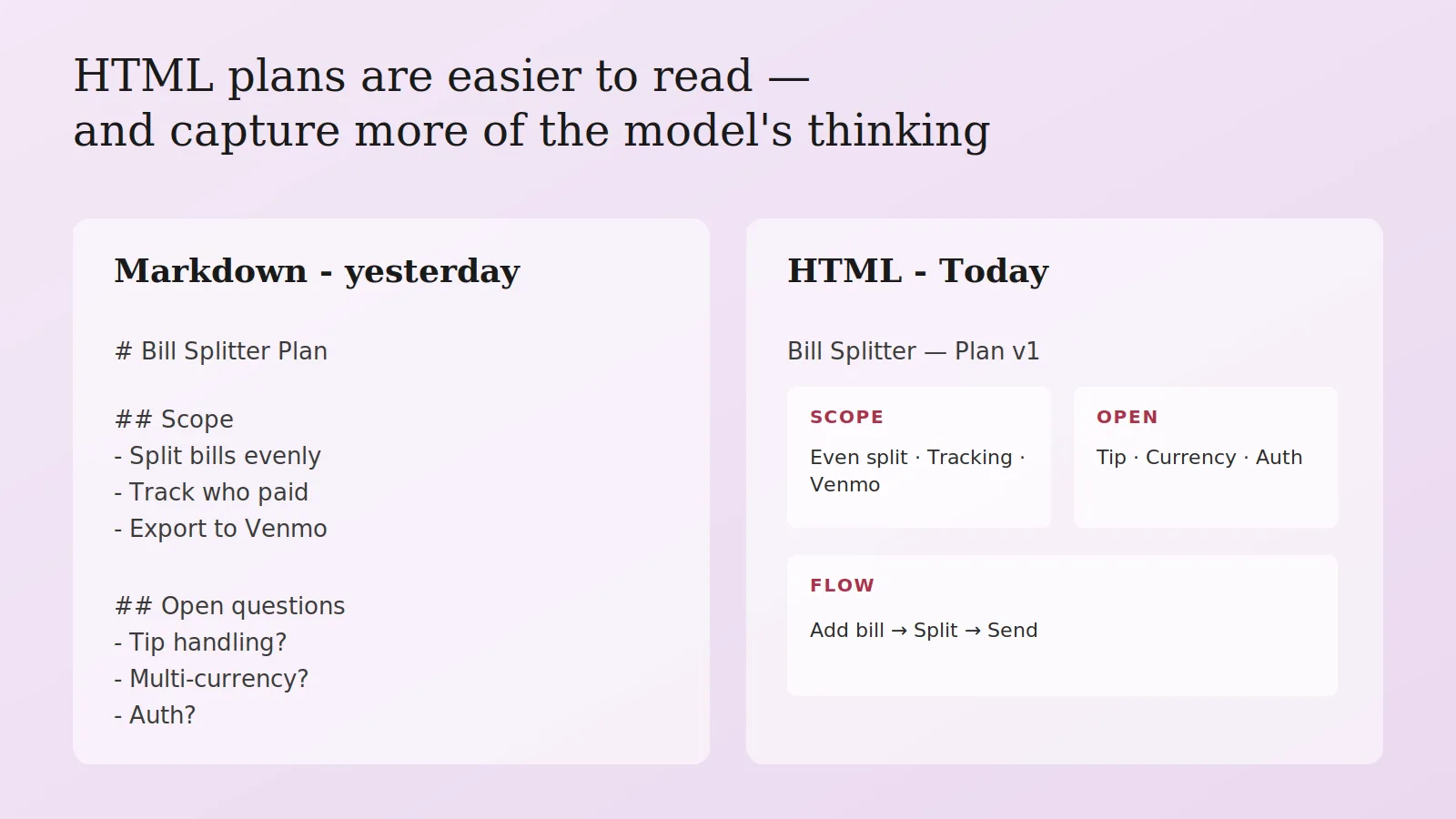
His slide put it directly: HTML plans are easier to read, and they capture more of the model’s thinking.
A Markdown plan for a bill-splitting app lists “Scope,” “Open Questions,” and a few bullets. The HTML version of the same plan shows scope, open questions, and the user flow as a visual diagram, all on one page. Same model. Same context. Different format. The HTML version is the one people actually read.
The most quotable line from the talk: “Stop describing taste. Start choosing between options.”
Instead of prompting Claude with “I want this app to look good” (vague, no constraint), try: “Create several different layouts and components, and let me choose between them. Present them using an HTML artifact.” Concrete options beat abstract taste every time.
Thariq’s full framework for long-running agents: remove ambiguity (make the agent interview you before it commits), understand and plan (plans you can actually read, in HTML), and integrate verification (build it in from the start, not bolted on later). The third point was illustrated with an architecture he calls verifiable-react. A React app structured so every piece can be observed, driven, and verified at runtime by an AI agent. Same code path serving humans, CI, and machines.
For builders: Generate your next implementation plan as an HTML file instead of Markdown. Ask Claude Code to add the diagrams, mockups, and code snippets you’d want to review. The output is hard to walk back from once you see it.
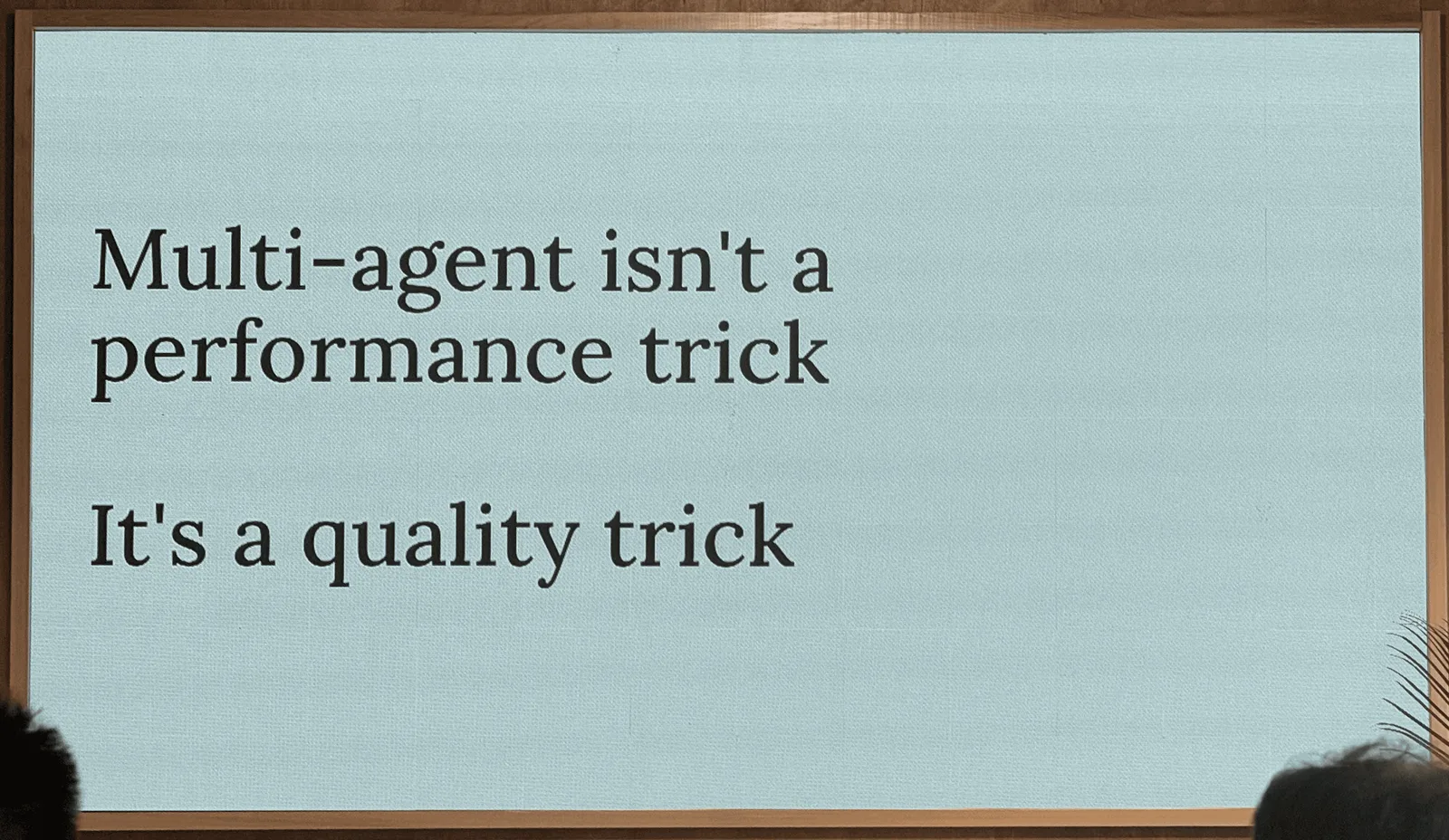
2. Multi-Agent Isn’t a Performance Trick. It’s a Quality Trick.
Nick Khami’s talk, “Designing multi-agent systems: When to split, when to sandbox, what to ship,” delivered the sharpest single insight of the day.
Nick is the founder of Mintlify, and he was open about a problem most multi-agent posts won’t admit. The first version of their AI docs generator failed. Not because it was slow. Because the docs it wrote read like a wiki. Dense, technical explanations of the codebase, not what users came for.
His diagnosis was the kind of insight that’s obvious in retrospect. A single agent with access to both the source code and the writing task will always lean on the internals. It can’t help itself. The code is right there, so it explains the code.
The fix: hide the code from the writer agent.
Mintlify now uses two agents. A discovery agent reads the code and builds a plan. A writing agent receives only the plan, with no code context, and writes the docs. With nothing technical to lean on, it has to write for users.
This is what multi-agent design is actually for. Not parallelism. Not throughput. Information shaping. Splitting agents prevents certain knowledge from flowing into certain decisions, and the output gets dramatically better.
For builders: Before reaching for a multi-agent setup for speed, ask one question. Is there a capability you want one of these agents to lack? If yes, split. If no, a single well-prompted agent is probably fine.
3. Stop Pitching. Start Listening.
Michael T. Brown’s talk, “Listen first. Then, keep thinking,” was the kind of story that reframes what building with AI actually means. He is a personal injury attorney and the founder of CrossBeam. He cannot code, cannot read it, by his own description. He won the first Global Claude Code Hackathon.
His diagnosis of why AI-assisted builds fail was direct: builders keep pitching their own ideas instead of talking to the people who actually live with the problem.
The fix: shut up and interview someone who knows.
Before writing a single prompt, Brown recorded conversations with domain experts: a mayor, a plan checker, a designer, a builder. Every feature in CrossBeam traces to one of those recordings. The conversation is the spec. Claude is the second pair of ears.
That turned into CrossBeam, an AI permit review system now in production city pilots. For under $6,000, he onboarded all 483 California cities and their entire municipal code. Same plan checkers. Same city budgets. Faster permits.
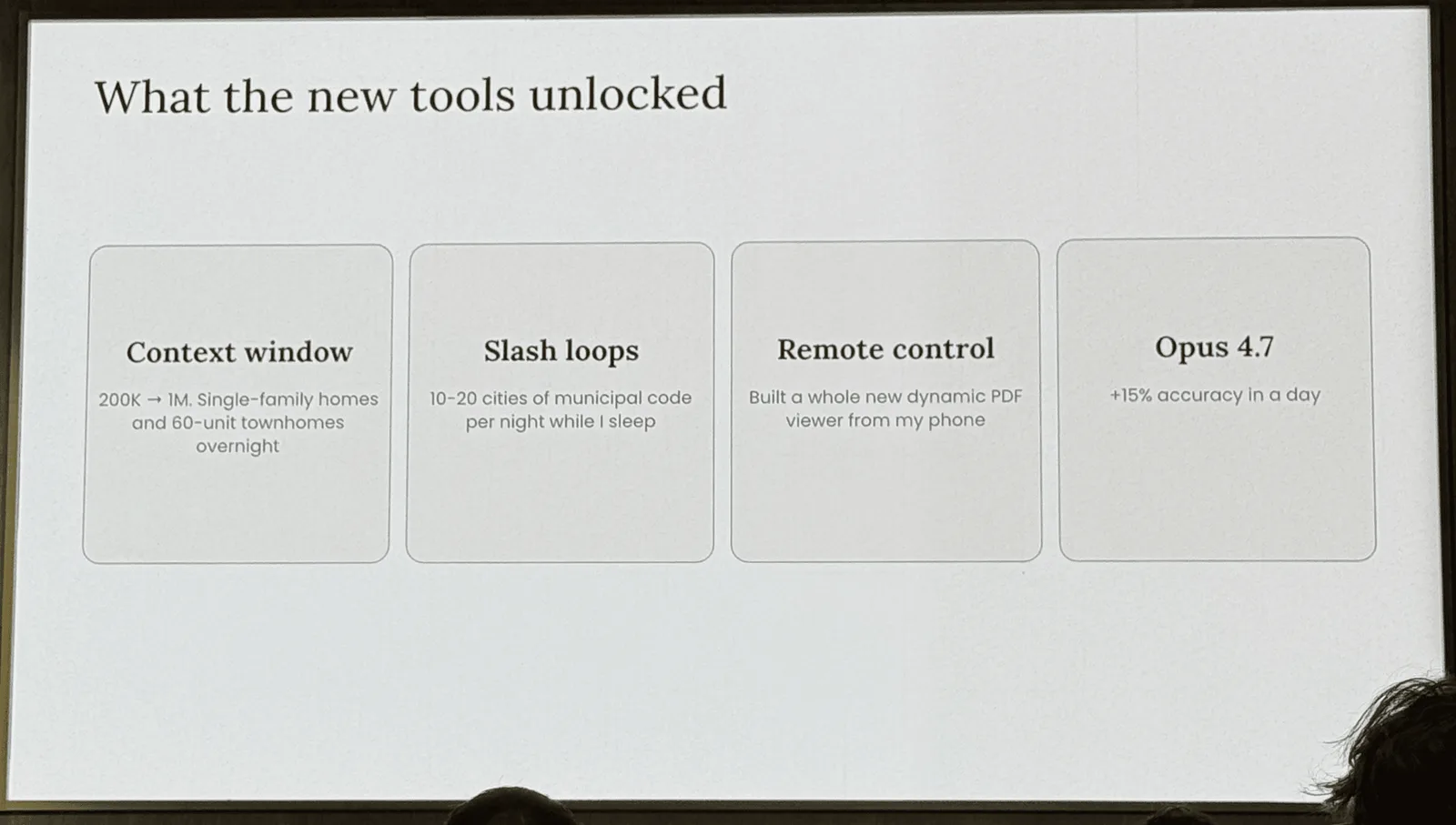
For builders: Before you prompt Claude, interview the person who lives with the problem. Let their words, not your assumptions, be the spec. The bottleneck usually isn’t capability. It’s the quality of the problem definition you bring to it.
What Anthropic Is Quietly Saying With This Event
Every detail of Code with Claude Extended was a message about who the event is for. The framing from Anthropic was direct: when anyone can build, the founder’s edge is knowing what to build and sticking with it. You don’t need a CS degree or an engineering team to ship real software anymore. You need a problem you understand and the will to solve it. That positioning ran through every stage. The Founder stage was about judgement calls. The Builder stage was about working demos and real code. The Workshops were the actual sessions Anthropic uses to train its own staff, adapted for builders in the room.
The signals matched the message. Cardputers in the welcome bags, not t-shirts. The workshops pushed to public GitHub the same day. The day-two perk announced on the opening slide as a code snippet: gift.unwrap("3 months Max 20x"). The talks weren’t Anthropic researchers showing benchmarks. They were founders shipping production software with Claude Code as the engine.
The implicit thesis of the day was that you can just build things now. Thariq builds HTML scratch tools instead of describing what he wants. Nick splits agents to engineer quality, not speed. Michael listens to a mayor and a plan checker and ships permit software for an entire state in three months. None of it required permission, a team, or a year of runway.
That’s the takeaway worth saving. Not which prompt to use. Not which framework to adopt. The simple fact that the gap between I have an idea and I have a working version is now measured in hours, not years.
If you weren’t in the room, the session recordings are going public soon. Worth watching when they drop.
That gap between idea and working version is what we help clients close. If you’re a founder or team that wants to build with AI and actually ship, talk to us.
FAQ
What is Code with Claude Extended?
Code with Claude Extended is the second day of Anthropic’s annual invite-only developer event, added in 2026 because demand for the original day far exceeded capacity. In-person attendance was free. The Extended day focuses on independent developers and early-stage founders, with founder talks, builder demos, and hands-on workshops from Anthropic’s Applied AI team. Sessions were not livestreamed but will be recorded and made publicly available after the event.
Where can I find the Code with Claude 2026 workshop materials?
The full workshop repository is open source at github.com/anthropics/cwc-workshops. It includes hands-on materials for agent battles, agents with memory, eval-driven agent development, agent decomposition, and the “How we Claude Code” workshop.
What is Claude Opus 4.7 and what’s new about it?
Claude Opus 4.7 was released on April 16, 2026. As of October 19, 2026, Anthropic lists it as a legacy model that is still available. The current generally available lineup is Claude Fable 5.1, Claude Opus 5.5, Claude Sonnet 5.5, and Claude Haiku 5.5. Anthropic’s model docs recommend Opus 5.5 for most workloads and Fable 5.1 for the hardest reasoning and long-running agent work.
Why use HTML instead of Markdown for AI agent plans?
HTML is richer than Markdown. It can render tables, diagrams, mockups, and interactive elements natively in any browser, which makes long plans actually readable. Markdown is still token-efficient and great for short context, but for implementation plans, design explorations, and architecture documents, HTML captures more of the model’s thinking in a format humans will actually read.
What is Michael T. Brown’s “Listen first. Then, keep thinking” approach?
Michael T. Brown, attorney and founder of CrossBeam, presented a method built around expert interviews before prompting. Rather than pitching his own ideas, he talked to a mayor, a plan checker, a designer, and a builder. Each conversation became a feature. The transcript became the spec, and Claude built from there, resulting in CrossBeam covering all 483 California cities for under $6,000.
What’s the M5 Cardputer that Anthropic gave out?
The M5 Cardputer ADV is a compact handheld device with a QWERTY keyboard and a small display, designed for makers and embedded experiments. Anthropic distributed them to Code with Claude Extended attendees with a card pointing to claude.com/cwc-makers, positioning Claude Code as the engine for hardware experimentation alongside professional software development.
Who were the featured speakers at Code with Claude Extended?
The featured speakers from Anthropic included Boris Cherny (Head of Claude Code), Angela Jiang (Head of Product, Claude Platform), Katelyn Lesse (Head of Engineering, Claude Platform), and Cat Wu (Head of Product, Claude Code). The full speaker lineup included founders and technical leaders from startups building on Claude, including Thariq Shihipar, Nick Khami, Michael T. Brown, Caitlin Colgrove, Michal Nedoszytko, Varun Anand, Madhav Jha, Shain Noor, Lauren Reeder, Felix Becker, Tina Vachovsky, Gagan Bhat, Tanveer Mittal, Matt Roknich, and Nicolai Ouporov, among others.
New Block Digital Agency is a full-stack technology, marketing, and creative agency based in Los Angeles. We help founders, brands, businesses, institutions, and government agencies build with intent. The agency is led by Raluchukwu Onyiuke, recipient of the Antelope Valley Future Leaders Award, recognized by the U.S. House of Representatives, the California State Senate, and the City of Lancaster.